
Temperature Transmitter
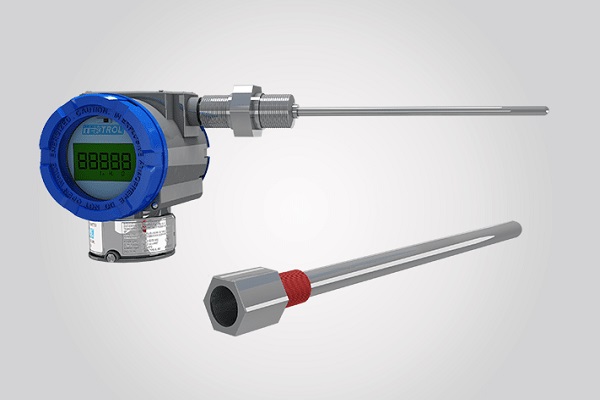
A temperature transmitter is an electronic device that converts weak signals from temperature sensors (like RTDs or thermocouples) into a standard, strong industrial signal (usually 4-20 mA or digital) for accurate, long-distance transmission to control systems (PLCs, DCS) for monitoring and control, effectively acting as a bridge between the sensor and the controller by amplifying, filtering noise, and scaling the temperature data.
How it Works:
-
Conversion:
The transmitter takes this tiny sensor signal, linearizes it, amplifies it, and converts it into a standardized output signal, often 4-20 mA, where 4 mA represents the low end of the temperature range and 20 mA the high end.
-
Transmission:
This scaled signal travels reliably over long distances via two wires to a controller.
-
Control:
The controller (like a PLC) reads the signal and takes action (e.g., turns on a heater).
-
Sensing:
A temperature sensor (RTD, Thermocouple, etc.) measures the temperature and produces a small electrical signal (voltage or resistance).
Key Functions:
- Signal Conversion: Translates sensor signals (mV, resistance) into standard 4-20 mA or digital outputs.
- Signal Conditioning: Amplifies the signal and filters out electrical noise for accuracy.
- Isolation & Protection: Can provide galvanic isolation to protect the control system.
- Scalability: Allows scaling the output (e.g., 4mA = 0°C, 20mA = 100°C).
Types:
- Head-Mounted: Fits directly into the sensor's connection head.
- DIN Rail Mounted: For panel mounting within control cabinets.
- Field-Mounted: Robust enclosures for harsh environments.