
Thermocouple Sensors
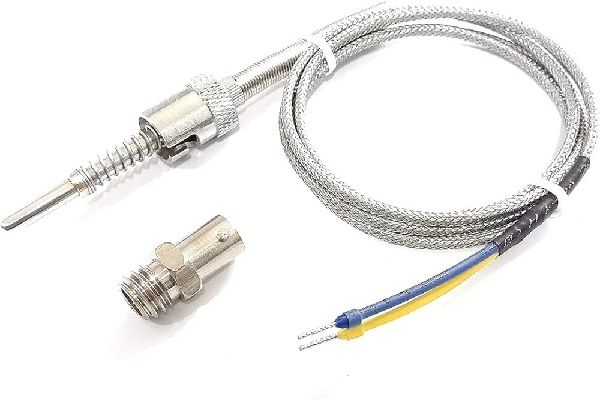
Thermocouple sensors are temperature sensors that use the Seebeck effect, generating a small voltage (millivolt) proportional to the temperature difference between two junctions of dissimilar metals, allowing for reliable temperature measurement across wide ranges in industrial, scientific, and home applications. They consist of two different metal wires joined at a "hot junction" (where temperature is measured) and connected to a reference point (cold junction), with the generated voltage correlating to the temperature.
Key Components & Working
- Two Dissimilar Metals: The core of a thermocouple is two different conductive metals (e.g., Chromel & Alumel for Type K) joined at one end.
- Hot Junction: The point where the two metals are joined, placed at the location where temperature needs to be measured.
- Cold Junction: The other end of the wires, kept at a known, stable reference temperature (often compensated for).
- Seebeck Effect: When the hot junction's temperature differs from the cold junction's, a thermoelectric voltage (EMF) is produced, which varies with the temperature difference.
- Measurement: A voltmeter measures this tiny voltage, which is then converted to a temperature reading using reference tables.
Characteristics & Types
- Versatile: Suitable for extreme temperatures, from cryogenic to over 1,700 °C, and various environments.
- Robust: Can be made durable for high vibration or harsh industrial settings.
- Common Types: Include Type K (NiCr/NiAl), Type J (Iron/Constantan), Type T (Copper/Constantan), etc., each with specific temperature ranges and properties.
Applications
- Industrial Process Control
- Home Appliances (Ovens, Water Heaters)
- Pharmaceuticals & Food/Beverage
- Scientific Research & Environmental Monitoring